Emotional Intelligence Tools to Calm Anxiety Fast

Calm & Clever: Emotional Intelligence Skills That Reduce Anxiety and Build Lasting Calm
Anxiety often feels unpredictable, but emotional intelligence adds structure: noticing what is happening inside, naming it accurately, and choosing a response that fits the moment. Calm & Clever is a practical eBook designed to turn emotional awareness into everyday tools—so anxious spirals become shorter, triggers feel more manageable, and calm becomes something that can be practiced and repeated.
Why emotional intelligence changes the anxiety cycle
Anxiety isn’t only a “thought problem” or only a “body problem.” It’s a loop that blends physical sensations, the meaning your mind assigns to them, and protective behaviors (like avoiding, over-checking, or seeking reassurance). Emotional intelligence (EI) helps interrupt that loop sooner—before it becomes a full-day detour.
Think of EI as three stabilizers you can strengthen over time:
- Awareness: catching anxiety earlier, when it’s still small and workable.
- Clarity: knowing what you’re actually feeling (not just “stressed”).
- Regulation: choosing what to do next—based on the moment, not the fear.
When feelings are labeled with precision (for example, “overwhelmed” vs. “scared”), the nervous system often de-escalates faster and decisions become easier. The goal isn’t to eliminate anxiety; it’s to prevent anxiety from running the day.
How emotional intelligence skills map to common anxiety moments
| Anxiety moment | EI skill to practice | What it helps with | A small next step |
|---|---|---|---|
| Racing thoughts at night | Emotional labeling | Reduces mental noise and catastrophizing | Name 3 feelings and 1 need (e.g., rest, reassurance, certainty) |
| Tight chest, fast heartbeat | Body awareness | Separates discomfort from danger | Track sensation location, intensity 1–10, and changes over 60 seconds |
| Overthinking a conversation | Perspective-taking | Challenges mind-reading and self-criticism | List 2 alternative explanations that are neutral |
| Avoiding a task | Self-management | Breaks avoidance-reinforcement loop | Do a 5-minute “starter step” only, then reassess |
| Snapping at someone | Impulse pause | Creates space between feeling and action | Use a 10-second pause + one clear boundary sentence |
What Calm & Clever focuses on (and what makes it practical)
Many anxiety resources are helpful in theory, but hard to use mid-day—when you’re juggling work, family, notifications, and a nervous system that’s already overloaded. Calm & Clever focuses on tools that work in real time, including during meetings, errands, parenting moments, and social situations.
- Simple frameworks you can use quickly, without needing the “perfect” environment.
- Direct connections between emotional intelligence and common triggers: uncertainty, conflict, perfectionism, overstimulation, and fatigue.
- Short, repeatable exercises designed for consistency rather than intensity.
- A skill-building approach where progress looks like quicker recovery, fewer spirals, and more flexible choices—not “never feeling anxious.”
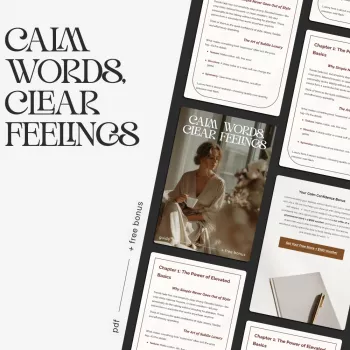
If you want a structured guide you can return to again and again, explore Calm & Clever: Mastering Emotional Intelligence to Tame Anxiety (eBook).
Core skills to practice daily
Lasting calm is rarely one big breakthrough; it’s the result of small, repeated micro-skills that make anxious moments less sticky. These core practices build a steady baseline and give you a reliable “next step” when anxiety flares.
- The 30-second check-in: identify emotion, intensity (1–10), and the most likely trigger in one sentence.
- Emotion vocabulary expansion: move beyond “fine/bad/stressed” to more precise labels like disappointed, uneasy, pressured, embarrassed, or lonely.
- Need-spotting: link emotions to needs (safety, rest, support, clarity, control, belonging) so the next action becomes obvious.
- A regulation menu: prepare 5–10 reliable options (breathing, movement, journaling, reaching out, sensory reset, planning, grounding) and choose based on context.
- Self-compassion as a skill: replace harsh self-talk with a supportive coaching tone that encourages follow-through.
For readers who like tracking patterns and building consistency, Using AI to Track and Enhance Your Daily Meditation Practice pairs well with EI work by making daily regulation habits easier to notice and maintain.
A quick reset routine for anxious spikes (3–7 minutes)
When anxiety spikes, you don’t need a perfect routine—you need a short sequence that reduces escalation and restores choice. Try this 3–7 minute reset:
If you’d like additional background on stress responses and relaxation basics, the American Psychological Association’s stress resources are a helpful reference.
Handling common triggers with emotional intelligence
For deeper education about anxiety disorders and when to seek help, the National Institute of Mental Health offers clear overviews and signs to watch for.
Who this guide fits best—and how to use it for lasting calm
Combine self-guided tools with professional support when needed. Persistent panic, severe impairment, or trauma-related symptoms often improve most with clinician support alongside daily skills. For additional coping guidance, the CDC’s stress coping resources are a useful complement.
Small environment supports can also reduce daily friction. If clutter adds to your sense of overwhelm, consider simple organization solutions like the Large Capacity Non-Woven Clothes & Quilt Storage Bag Organizer to make “resetting the space” a quick win rather than a big project.
FAQ
Can emotional intelligence reduce anxiety even if anxious thoughts keep returning?
Yes. Returning anxious thoughts are normal; emotional intelligence reduces their impact by helping you notice them earlier, label what you’re feeling more precisely, and choose a response that shortens the spiral’s intensity and duration.
How quickly can changes be noticed with daily practice?
Many people notice small shifts within a week or two, such as faster recovery and less avoidance. Stronger baseline calm typically builds over consistent weeks, especially when practice is repeatable and not perfection-driven.
Is this a replacement for therapy or medication?
No. It’s an educational, self-help skill guide that can complement therapy or medical care; if symptoms are severe, persistent, or disruptive, professional support is the safest next step.














Leave a comment