Build Real Resilience: Inner Strength That Lasts

Strength You Can Rely On: A Practical Path to True Resilience and Inner Strength
Inner strength isn’t a personality trait reserved for a few; it’s a set of skills that can be learned, practiced, and reinforced. True resilience combines emotional regulation, clear thinking under pressure, supportive relationships, and steady habits that make hard days more manageable. This guide lays out a realistic framework for building strength that holds up in daily stress, setbacks, and uncertainty—without relying on motivation alone.
What True Resilience Looks Like (and What It Doesn’t)
Real resilience is less about “powering through” and more about recovery and adaptation. It’s the ability to return closer to baseline after stress, learn from what happened, and adjust your approach the next time pressure hits.
- Resilience is recovery + learning: You don’t avoid stress; you develop a quicker, kinder bounce-back.
- Common myths: Resilient people never struggle, stay positive 24/7, or handle everything alone.
- Healthy signals: Flexible thinking, self-compassion, consistent self-care, and practical problem-solving even when emotions are loud.
- When “toughing it out” backfires: Burnout, emotional numbing, avoidance, and relationships getting strained from unspoken needs.
Authoritative guidance from the American Psychological Association emphasizes that resilience is buildable through behaviors, thoughts, and actions—meaning progress is available even if life currently feels heavy.
Start with a Personal Baseline: Stress, Triggers, and Strengths
Resilience becomes practical when it’s specific. Before adding new habits, get a quick read on what typically knocks you off balance and what already helps you recover.
- Identify your top 3 repeating stressors: Workload, conflict, uncertainty, health, finances, or caretaking demands.
- Notice early warning signs: Sleep changes, irritability, rumination, headaches, social withdrawal, or “everything feels harder.”
- Map triggers to values: Stress often spikes where something important is at stake—respect, safety, stability, belonging, meaning.
- Name existing strengths: Persistence, humor, organization, empathy, creativity—use what’s already there instead of starting from zero.
Quick Resilience Self-Check
| Area | Common signal | Supportive action |
|---|---|---|
| Body | Tension, fatigue, sleep disruption | 10-minute walk, hydration, consistent bedtime window |
| Mind | Catastrophizing, racing thoughts | Write a 3-line reality check: facts, fears, next step |
| Emotions | Overwhelm or numbness | Name the feeling + rate intensity 1–10 + choose one soothing tool |
| Behavior | Procrastination, avoidance | 2-minute starter task + set a tiny finish line |
| Relationships | Isolation, snapping at others | One honest check-in message + one boundary |
| Meaning | Feeling stuck or pointless | Reconnect to a value + schedule one aligned action this week |
Core Skills for Building Inner Strength
Think of resilience as a small set of trainable skills that work together. You don’t need all of them at once; one reliable tool is enough to start changing outcomes.
- Emotional regulation: Use breathing techniques, grounding, and “name it to tame it” labeling. The goal isn’t to erase feelings; it’s to reduce overwhelm so you can respond wisely.
- Cognitive flexibility: Shift from “this is impossible” to “what’s one workable option?” This keeps you in problem-solving mode instead of all-or-nothing thinking.
- Distress tolerance: Stay present with discomfort long enough to choose your next move. Discomfort often spikes right before a healthy boundary, honest conversation, or needed rest.
- Self-compassion as stamina: Fewer shame spirals means faster restarts after setbacks. The National Institute of Mental Health highlights coping approaches that support long-term mental well-being, especially during sustained stress.
- Boundary setting: Protect time, energy, and attention so recovery can happen. Resilience isn’t just endurance—it’s preventing depletion.
Daily Habits That Make Resilience Automatic
When life gets busy, resilience succeeds or fails on basics. Small, repeatable habits lower your stress “background noise,” so you don’t have to rely on willpower.
- Stabilize essentials first: Sleep consistency, protein/fiber at meals, hydration, and light movement.
- Use micro-habits: Try 60–120 second actions—refill water, step outside for one deep exhale cycle, write one sentence in a journal.
- Build a reset routine: A predictable sequence after stress (pause, breathe, choose one next step) reduces decision fatigue.
- Design the environment: Make helpful habits easier (journal visible, distracting apps blocked, workout clothes ready).
- Track lightly: Mood, sleep, and triggers—just enough to spot patterns and avoid guessing.
If stress feels constant, the CDC’s stress management resources reinforce a simple truth: tiny actions done consistently can reduce the load over time.
Strength in Hard Moments: A Simple 5-Step Resilience Protocol
Relationship Resilience: Support Systems and Healthy Boundaries
A Guided Plan to Put It All Together
- Best for: Stress-prone schedules, frequent setbacks, and anyone who wants a repeatable routine for inner strength.
- Look for: Practical exercises, reflection prompts, habit planning, and simple progress tracking.
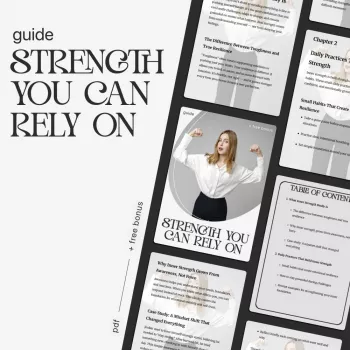
- Recommended resource: Strength You Can Rely On | Digital Guide for Building True Resilience | How to Build Inner Strength (digital download).
To reinforce calm and consistency, consider pairing your resilience routine with a mindfulness tracking system like Using AI to Track and Enhance Your Daily Meditation Practice | Guide for Mindfulness Growth | Digital Download | ai tracker for daily meditation. When you can see patterns (sleep, stress spikes, meditation streaks), it becomes easier to adjust before burnout builds.
FAQ
How long does it take to build real resilience?
Small improvements can show up in days when you use basic regulation tools (breathing, grounding, labeling). Deeper, more reliable resilience usually develops over weeks to months with consistent habits, reflection, and support.
What is the fastest way to calm down when stress spikes?
Try extended-exhale breathing (exhale longer than inhale), a quick 5-4-3-2-1 grounding scan, or labeling the emotion you’re feeling. Once you’re even slightly calmer, choose one small next step to regain clarity.
What if resilience feels like pretending everything is fine?
Resilience includes acknowledging pain, setting boundaries, and asking for help when needed. It’s adaptive coping—staying honest about what’s hard while still choosing actions that protect your well-being.














Leave a comment