Beginner Home Strength Routine: 3-Day Bodyweight Checklist
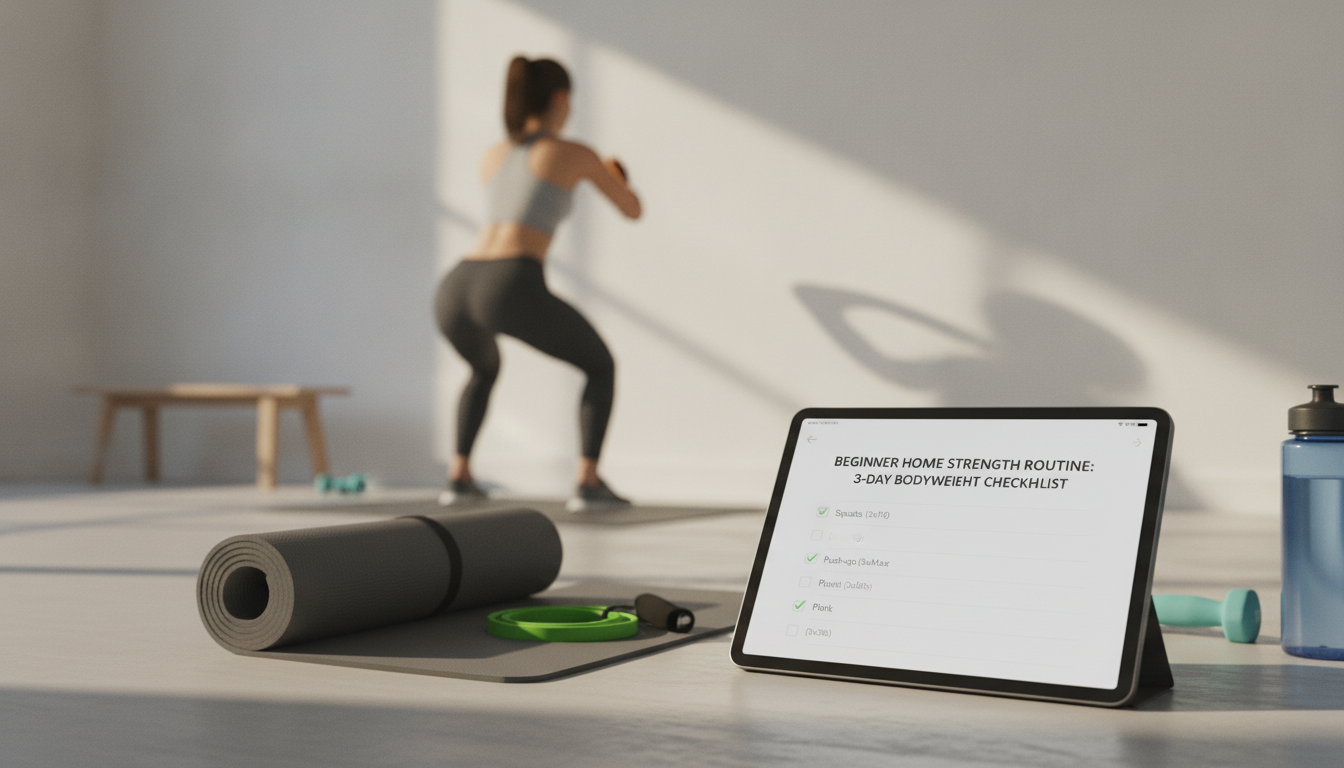
Strength Made Simple: A Beginner-Friendly Home Routine With a Bodyweight Checklist
Building strength at home can be straightforward when the plan is simple, repeatable, and easy to track. This beginner-friendly bodyweight routine focuses on safe movement patterns, steady progress, and a practical checklist approach so workouts feel doable—even on busy days.
What “getting stronger” means for beginners
Early strength gains are often less about “muscling through” and more about learning control. Think of strength as a skill: you’re practicing key movement patterns—squat, hinge, push, pull, carry, and core bracing—so your body can create tension in the right places while staying stable in the right positions.
- Consistency beats intensity at first: Cleaner technique, fewer skipped sessions, and less next-day soreness usually means better month-to-month progress.
- Simple progress markers: More reps with good form, longer holds, a slower lowering phase, or slightly shorter rest.
- Realistic timeline: With 2–4 sessions per week, noticeable improvements commonly show up in about 2–4 weeks—especially in confidence and control.
Quick readiness check: equipment, space, and warm-up
You don’t need a home gym to start. A little setup prevents interruptions and helps you focus on form instead of logistics.
- Space: Clear a floor area where you can extend your arms and legs. Keep a sturdy chair or sofa edge nearby. A wall can help with balance work.
- Optional add-ons: A backpack (for light loading), a towel (for slider-style moves on smooth floors), and a mat (for comfort during planks).
- Warm-up (5–8 minutes): Brisk marching, arm circles, hip hinges, bodyweight squats to a chair, and gentle plank practice.
- Pain vs. effort rule: Muscle effort and mild burning are normal; sharp pain, joint pinching, or dizziness are stop signs.
For general activity benchmarks that support strength training, see the CDC’s adult physical activity guidance and the World Health Organization activity guidelines.
The core movement menu (choose the easiest version that feels controlled)
Select variations that let you move smoothly, keep breathing, and stop with good posture. If form breaks down fast, the move is currently too hard—regress and build up.
Squat pattern
- Chair sit-to-stand
- Bodyweight squat
- Paused squat (brief hold at the bottom)
Hinge pattern
- Hip hinge drill to wall (tap hips back)
- Romanian hinge with hands on thighs (slide hands down slightly)
- Single-leg hinge (assisted, fingertips on wall/chair)
Push pattern
- Wall push-up
- Incline push-up (counter/table)
- Knee push-up
- Full push-up
Pull pattern (no bar required)
- Backpack row (hug a backpack to chest and row it)
- Towel row against a sturdy door handle (use caution and test stability)
- If pulling options aren’t available: prone “Y-T-W” raises for upper back
Core/bracing
- Dead bug
- Plank on knees
- Plank
- Side plank (short holds)
Leg stability
- Step-ups on a stair
- Split squat (assisted)
- Reverse lunge (controlled)
Beginner home strength routine (3 days/week, 20–30 minutes)
This plan keeps decisions minimal: warm up, hit five main moves, and optionally finish with a short burst of easy conditioning. Use an effort level that leaves 1–3 good reps “in the tank” so form stays clean.
- Rest: 45–90 seconds between sets (longer if you can’t control your breathing yet).
- Structure: Warm-up → 5 main moves → optional finisher (3–5 minutes) → quick cool-down.
Workout A (full body)
- Sit-to-stand squat
- Incline push-up
- Hip hinge
- Backpack row (or Y-T-W raises)
- Plank hold
Workout B (full body)
3-Day Weekly Checklist Plan (Repeat for 4 Weeks)
| Day | Main Focus | Exercises | Sets x Reps / Time | Checklist |
|---|---|---|---|---|
| Day 1 (A) | Full-body basics | Sit-to-stand squat; Incline push-up; Hip hinge; Backpack row (or Y-T-W); Plank | 2–3 x 6–12 (plank 15–30s) | Warm-up done; Form felt controlled; Notes recorded |
| Day 2 | Recovery / mobility | Easy walk; Gentle hips/ankles/shoulders mobility | 15–30 min | Movement completed; Energy check |
| Day 3 (B) | Full-body stability | Step-ups; Wall/incline push-up; Assisted split squat; Backpack row; Dead bug | 2–3 x 6–12 (dead bug 6–10/side) | Warm-up done; Balanced left/right; Notes recorded |
| Day 4 | Optional light cardio | Walk, bike, or low-impact intervals | 10–25 min | Breathing comfortable |
| Day 5 (A) | Repeat + refine | Same as Day 1 (A) | 2–3 x 6–12 (plank 15–40s) | Added 1 rep or improved form; Notes recorded |
| Day 6–7 | Rest | Light movement if desired | — | Recovered; Sleep & hydration check |
How to progress without guessing
For foundational resistance training guidance, the American College of Sports Medicine resistance training resources are a helpful reference point.
Common beginner mistakes (and easy fixes)
Digital checklist option for staying consistent
- Strength Made Simple: Easy Exercises to Build Your Power at Home (digital download) — a beginner-friendly routine with form cues and a repeatable weekly template.
- Using AI to Track and Enhance Your Daily Meditation Practice (digital download) — a structured way to track consistency and build a calmer daily rhythm alongside training.
FAQ
How many days per week should a beginner do strength workouts at home?
Two to four days per week works well for most beginners, with three days often being the sweet spot for learning form while still recovering. Keep at least one rest or light-movement day between harder sessions so you can repeat quality workouts consistently.
Can bodyweight training really build strength without equipment?
Yes—strength can increase through progressive overload using reps, slower tempo, longer ranges of motion, and harder variations like lower inclines for push-ups. Adding simple loading (like a backpack) or changing leverage can also make the same movement more challenging.
How long should a beginner home workout take?
About 20–30 minutes is plenty when you include a short warm-up and focus on clean sets rather than rushing. Consistent, high-quality reps beat longer sessions that drift into sloppy form.















Leave a comment