Own Your Glow: Daily Body Confidence on Ordinary Days

Body confidence rarely arrives as a dramatic “before and after.” More often, it’s built the same way a steady mindset is built: small, repeatable choices that soften self-talk, reduce avoidance, and make daily life feel more livable in your own skin. This guide focuses on practical strategies for “ordinary” days—when motivation is low, comparison is loud, or routines get messy—so you can show up for your life without body thoughts running the whole show.
What Body Confidence Looks Like in Real Life
Body confidence isn’t constant positivity. It’s the ability to move through your day with your body in the background, not the center of every decision. It can look like going to the brunch anyway, taking the photo anyway, or wearing what fits now—even when you feel imperfect.
- Confidence can coexist with discomfort: you can feel self-conscious and still be present in relationships, work, and memories.
- Progress is often behavioral first: you wear the outfit, you stop canceling plans, you buy jeans that fit—then emotional comfort catches up later.
- Key signs of growth: fewer body-checking rituals, less avoidance (mirrors, clothes, social plans), and quicker recovery after a trigger.
If body-image distress feels intense or persistent, it may help to explore reputable education and support resources like the American Psychological Association’s overview of body image.
Common Confidence Blockers (and Gentle Reframes)
Most confidence blockers aren’t character flaws—they’re learned patterns. The goal isn’t to “win” against every thought; it’s to practice a reframe that makes the next choice kinder and more doable.
| Moment | Helpful reframe | One action in under 2 minutes |
|---|---|---|
| Seeing a “perfect” photo online | Curated images aren’t a standard for worth | Close the app and take 3 slow breaths |
| Clothes feel tight | A clothing size is information, not identity | Change into a comfortable outfit without self-criticism |
| Catching a “bad angle” in the mirror | Bodies fold and move; that’s normal | Shift posture, then redirect attention to the task |
| Negative self-talk during a workout | Movement is care, not punishment | Lower intensity and name one body function to appreciate |
Comparison spirals can be especially sticky. If you notice “they look better” popping up, try: “Their body is not a verdict on mine.” It’s simple, not magical—and it creates just enough space to choose your next step.
Daily Mindset Practices That Actually Fit Busy Days
Busy days don’t need big rituals. They need tiny resets that interrupt the autopilot of criticism and steer you toward care.
- A 10-second reset: place a hand on your chest and say a neutral truth: “This is my body today; I can still live my life.”
- Language swap: trade appearance-based statements (“I look…”) for experience-based ones (“I feel…,” “I need…,” “I’m noticing…”).
- Body-neutral affirmations: focus on capability and care—sleep, hydration, strength, digestion, rest—without forcing positivity.
- Boundary phrases for body talk: “I’m working on not discussing weight; tell me about your week instead.”
- Mini gratitude without pressure: pick one function (breathing, walking, hugging, healing) rather than trying to love everything at once.
For extra support with body image education and resources, the National Eating Disorders Association (NEDA) body image page can be a helpful starting point.
A Simple Routine for Building Self-Love Without Forcing It
Self-love doesn’t have to feel like a pep talk. It can look like keeping small promises to yourself—especially when you’re not in the mood.
Morning (1 minute): choose a “care anchor”
Pick one non-negotiable act of care—breakfast, water, stretching, meds, skincare—and treat it like a promise to your body. Not a reward. Not something to earn.
Midday (1 minute): ask a practical check-in
Evening (2 minutes): log one non-appearance win
A clothing strategy that protects your peace
Keep 2–3 go-to outfits that feel good now—physically and emotionally. Avoid “saving comfort” for a future body. If your closet is packed with clothes that don’t fit your current life, consider boxing them up so the daily visual triggers are reduced. A simple organizer like the Large Capacity Non-Woven Clothes & Quilt Storage Bag Organizer can make it easier to separate “not right now” items without turning it into a self-judgment moment.
Support Tools: Guided Prompts and a Real-World Plan
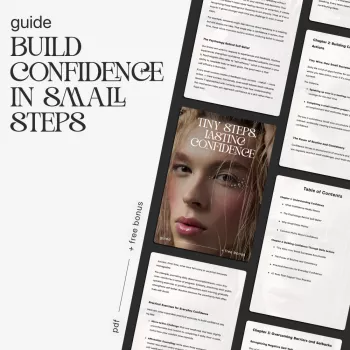
If you want a guided, step-by-step approach, Own Your Glow: A Real-World Guide to Body Confidence is designed for daily mindset and self-love with practical prompts for real situations (mirrors, photos, social events, shopping, and tough days).
Pairing body confidence work with a consistent mindfulness habit can also help you notice thoughts without treating them as facts. Using AI to Track and Enhance Your Daily Meditation Practice offers a simple structure for building daily meditation and reflection—especially if consistency is hard when life gets busy.
Getting Started: A 3-Day Confidence Micro-Challenge
FAQ
How long does it take to build body confidence?
Timelines vary, but confidence tends to grow through consistent daily actions—especially reduced avoidance and gentler self-talk. Measure progress by behaviors (wearing the outfit, going to the event, setting a boundary) rather than expecting constant positivity.
What can help on days when body image feels unbearable?
Use a short plan: switch to comfort clothing, reduce mirror time and social media, repeat a body-neutral statement, and take a few slow grounding breaths. If distress is frequent or tied to eating behaviors, consider reaching out to a qualified professional for support.
Is body confidence the same as self-love?
They’re related but different: self-love is a practice of care and respect, while body confidence is the ability to live without constant body worry. Self-care habits can support both by building trust with yourself over time.














Leave a comment