Build Real Autonomy: Lidar + Vision Python Robot Tank
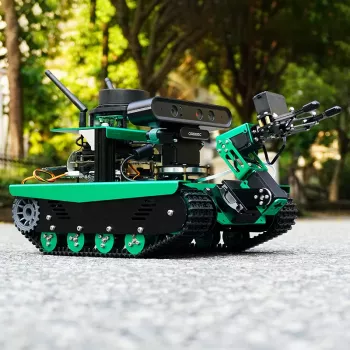
AI Vision Robot Tank Kits: Where Lidar, Vision, and Python Start Feeling Like “Real Robotics”
An AI-enabled tracked robot kit that pairs lidar-based ranging with camera vision and Python control is a practical way to move from basic motor demos into autonomy: obstacle avoidance, mapping, and perception-driven behaviors. A tank-style chassis adds stability on carpet transitions and thresholds, while lidar and a camera give the robot multiple ways to “understand” its surroundings—especially useful when lighting changes or obstacles are hard to see.
What This Robot Tank Kit Is Designed To Do
Unlike simpler line-followers or two-wheel kits, a lidar + vision tank platform is built for experiments where sensing and navigation are the point—not just driving.
- Tracked (tank) chassis for confident movement over uneven indoor surfaces compared with typical wheeled kits.
- Lidar sensing for distance measurements and environment scanning, supporting mapping and navigation experiments.
- Camera-based vision for object detection, line following, color/marker tracking, and perception-driven behaviors.
- Python programming workflow suited to iterative testing, rapid prototyping, and integration with common robotics libraries.
- Best suited for advanced learning, lab demos, and capstone-level projects where sensing and autonomy matter.
Core Hardware and Capabilities to Expect
Lidar module
Lidar provides direct range readings that are extremely useful for “don’t hit things” logic and for building a rough 2D map of a room. Practical results depend on scan rate, angular resolution, and how solidly the sensor is mounted—vibration can show up as noisy scans.
Vision sensor (camera or depth camera)
A camera enables 2D perception tasks like recognizing markers, tracking colors, and detecting edges/lines. Depth cameras can add distance awareness for vision-driven navigation, but they also increase compute load and can require more careful driver setup.
Compute platform and motor control
Most kits in this category run a Linux-based stack where Python scripts handle sensor reads, control loops, and optional robotics middleware. If motor encoders are included, odometry becomes far more repeatable—especially when you begin mapping or trying to return to a waypoint.
Power system
Motors plus lidar plus camera can create current spikes that smaller batteries struggle with. A sensible plan includes safe charging habits, avoiding deep discharge, and setting conservative speed/acceleration limits until the platform is tuned.
Software Stack and Learning Outcomes (Python + Robotics Concepts)
The most valuable part of a lidar-and-vision tank kit is the way it forces practical robotics habits: timing, calibration, and debugging sensor-driven behavior.
- Python control basics: reliable control loops, time-based updates, and safe motor commands.
- Perception pipelines: turning frames into features (edges, colors, markers) and then into decisions (turn/stop/track).
- Lidar processing: filtering noisy readings, clustering obstacles, and generating simple local cost maps.
- Navigation concepts: waypoint following, reactive obstacle avoidance, and introductory path planning approaches.
- If supported: ROS/ROS2 ideas like nodes, topics, TF frames, and sensor fusion that transfer to larger robots.
For reference documentation while building, the official resources for Python, OpenCV, and ROS are strong starting points when you need exact API behavior and configuration details.
Typical Projects: From First Drive to Autonomy
- Teleoperation: keyboard or gamepad control with live camera feed; add speed ramps for smoother starts/stops.
- Reactive obstacle avoidance: stop-and-turn behaviors using lidar thresholds; tune for narrow spaces and reflective surfaces.
- Mapping demo: drive around a room to produce a 2D occupancy-style map; compare results with/without wheel odometry.
- Vision-triggered actions: follow a colored target, respond to AprilTags/ArUco markers, or stop at a detected sign.
- Patrol routine: timed route + lidar safety bubble + vision event triggers (pause when a marker is seen).
Setup Checklist Before the First Run
Key Specs to Compare When Choosing a Configuration
| Feature | Why it matters | What to look for |
|---|---|---|
| Lidar scan rate/resolution | Improves obstacle detection and mapping detail | Stable scans, consistent ranges, adequate resolution for indoor navigation |
| Camera or depth camera | Enables vision tasks and better scene understanding | Reliable drivers, decent frame rate, optional depth for distance-aware behaviors |
| Compute performance | Prevents lag in perception and control loops | Enough CPU/GPU/RAM for simultaneous lidar + vision + navigation |
| Wheel encoders/odometry | Reduces drift and improves map quality | Encoder feedback, solid kinematic model, calibration utilities |
| Chassis stability | Reduces vibration and improves sensor data quality | Rigid frame, secure mounts, manageable track tension |
Who This Kit Fits Best (and When It’s Overkill)
Featured Product
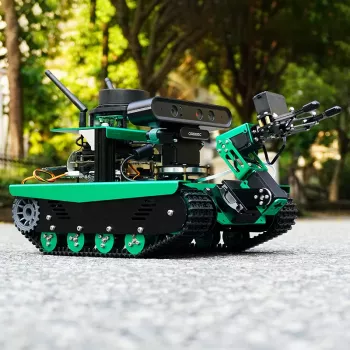
AI Vision Robot Tank Kit with Lidar & Python Programming combines tracked mobility with lidar mapping and camera-based perception for advanced robotics projects. It’s a solid starting point for a structured progression—teleop → reactive avoidance → mapping → autonomous navigation—without having to redesign the platform each time the project becomes more ambitious.
Helpful Add-Ons for a Clean Build Space
- Rustic Wood Sideboard for storing batteries, tools, spare tracks, and fasteners in one spot.
- Southeast Asian-Inspired Bamboo and Rattan Pendant Chandelier for consistent overhead lighting that can make camera testing more repeatable.
- Luxury Marble Round Coffee Table with Gold Stainless Steel Base as a sturdy display surface for demos, presentations, or a controlled “arena” setup.
FAQ
Does lidar help if the robot already has a camera?
Yes. Lidar provides direct distance measurements that remain reliable even when lighting changes, while a camera excels at recognizing and tracking visual targets; using both together generally makes navigation more robust.
What level of Python knowledge is needed to get started?
Comfort with variables, functions, and basic loops is enough to begin. Robotics adds timing, sensor I/O, and debugging skills, so starting with teleop plus simple sensor-read tests helps build confidence quickly.
Can it map a room and navigate autonomously right away?
It can demonstrate mapping and navigation, but results depend on the configuration, calibration, odometry quality, and tuning. Expect incremental improvements rather than instant, perfect SLAM in a brand-new environment.













Leave a comment